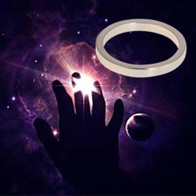
Magical rings are less adornments than tools—transformers and condensers, lenses and windows—through which the flow of energy can change both qualitatively and quantitatively.


Other Magic
Пишите мне
Enmerkar's Blog содержит более тысячи авторских статей эзотерической направленности.
Введите интересующий Вас запрос — и Вы найдете нужный для Вас материал
Magical rings are less adornments than tools—transformers and condensers, lenses and windows—through which the flow of energy can change both qualitatively and quantitatively.
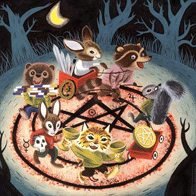
Using the six-pointed star as the structuring “skeleton” of a Ritual, as opposed to the hexagram’s “direct,” defensive use, requires significantly greater additional expenditure of energy


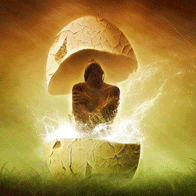
Without falling into denial or into self-assertion at any cost, the Magus finds a truly unique Way of self-expression, self-development, and self-realization


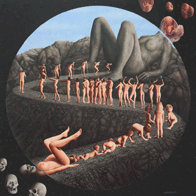
Only if such efforts are genuinely made, if the striving to break free from the conditioned nature of manifested existence is truly unquenchable and truly dominates the motivational sphere of the mind, is it possible to achieve success in it.


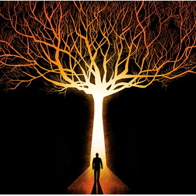
Every traveler must clearly understand that destruction, collapse, and downfall are utterly inevitable and necessary as part of the Way.
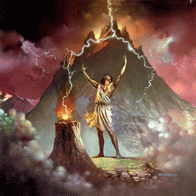
Theurgy as a distinct domain of Magic is aimed, above all, at the development of the Magus and the world, occurring interdependently and in mutual accord, and consists in the search for and activation of higher psycho‑ or macrocosmic forces that effect this transformation.

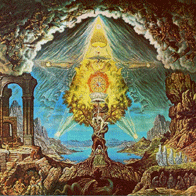
The Law opens those possibilities for which it was proclaimed in the first place: the right and the capacity to affirm an individual stream of mind as an autonomous supreme value, since, when considered in its absolute sense, it proves indistinguishable from the universal stream, and is also equal (though not identical) to any other particular stream.
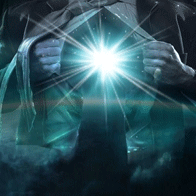
The Myth describes the primordial duality of Mind and Medium as two consubstantial properties of the One in the aspect of its manifestation.
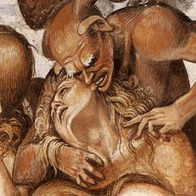
When making a correct “diagnosis” one must proceed with the utmost care and deliberation, understanding that a wrongly identified cause will not only fail to help therapy but may also worsen the pathogenesis.

The task of the Magus is to exhaust what can be exhausted, transform what must be transformed, and overcome what must be overcome.

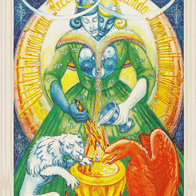
Every action of a manifested being takes place under the influence of a system of two interacting stimuli — the drive to satisfy needs and the drive to obtain pleasure — which, though interdependent, can be experienced as distinct motivational schemes.

Alongside contacts with “one’s own reflections,” the ritual activity of the Magi has always been aimed at interactions with other forms of mind.
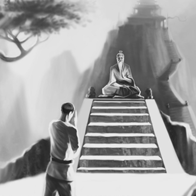
It is easiest for the mind to accumulate Power either by entering into interaction with one who possesses that Power or by objectifying within itself those states in which that Power is available.