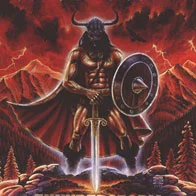
Even the “benign” use of iron is fraught with the risk of its power running out of control — the cruelty of the fiery depths is simply too great, its thirst for hot blood too strong — blood flowing through iron and from beneath iron.



Other Magic
Пишите мне
Enmerkar's Blog содержит более тысячи авторских статей эзотерической направленности.
Введите интересующий Вас запрос — и Вы найдете нужный для Вас материал
Even the “benign” use of iron is fraught with the risk of its power running out of control — the cruelty of the fiery depths is simply too great, its thirst for hot blood too strong — blood flowing through iron and from beneath iron.
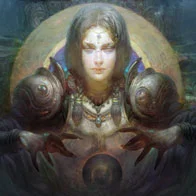
The image of the Great Dark Mother, who gave birth to demons and to the World Serpent himself, has been familiar to humanity since ancient times.

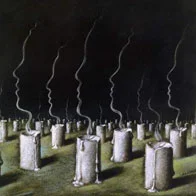
Despite its elusiveness, the soul is a rather fragile substance that requires constant attention and care.

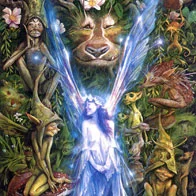
Everything humans attain only by balancing their dominant principle with a binary one is given to the Fair Folk “from birth.”
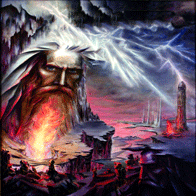
Passing through the Kolo of Svarog carries the mind through the heights and depths of the Psychocosm, engendering in it the possibility and desire for creative activity.

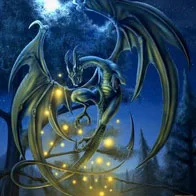
The Magus saddles a dragon — he does not renounce the elemental forces; he brings them under his control.

The whole question is what is closer to a particular person — to develop the mind or its Conductor, to live in an infinitely deep world, or in a multiplicity of worlds.


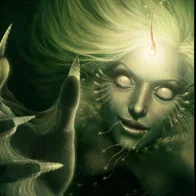
Magi who seek to minimize Lamassu’s influence on the Psychocosmos have developed numerous strategies aimed at detecting and expelling the Parasite of mind.
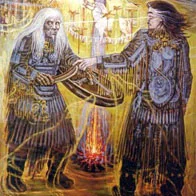
Any true art is transmitted – the student takes from the Master something more than a pattern of action, he receives the energy of that action.

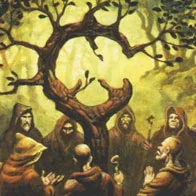
Meetings of the Magi, when justified and prepared, can serve as a significant aid in the common Battle for the Freedom to be oneself.
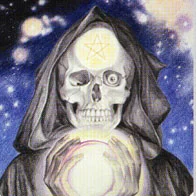
For the Magus it is crucial not to cling to exhausted forms, ideas, and concepts, but to find the strength to destroy the habitual picture — so as to be able to rise to a new level of development.
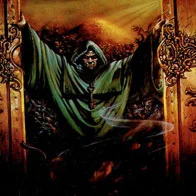
Anyone who feels the fading of the ability to love in their heart must understand that this “shard of the troll’s mirror” can very well indicate that a predator is gnawing at them.
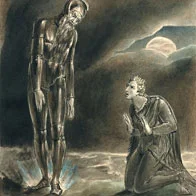
An encounter with the Breath of Bones is the same as encountering any corpse — unpleasant, ritually unclean, but in itself not dangerous — unless, of course, you make mistakes.