
For a Magus striving to constructively actualize both forces — attraction and repulsion — and to avoid becoming dependent on either, it is vitally important to evade the traps of acceptance and rejection.


Other Magic
Пишите мне
Enmerkar's Blog содержит более тысячи авторских статей эзотерической направленности.
Введите интересующий Вас запрос — и Вы найдете нужный для Вас материал
For a Magus striving to constructively actualize both forces — attraction and repulsion — and to avoid becoming dependent on either, it is vitally important to evade the traps of acceptance and rejection.
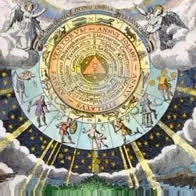
The transformation of the duodecimal system of Gilgul’s “self-enclosure” into the duodecimal process of the Great Doing is a direct consequence of a clear understanding of this system.


The destructive darkness of the “anti-cosmos” and the engulfing, dissolving darkness of chaos differ in nature and in their mechanisms of influence on the “daytime” mind.


Regardless of the terminology and imagery a particular practitioner uses, interaction with the Enlightening matrices is a necessary component of the Way and an integral part of any transcensus, any initiation that takes place with it.
To determine whether a given pull is a desire, and therefore whether it requires fulfillment, one must, first, find its roots (a desire is rooted in the depths of the mind, a need – in the body or personality, a whim – in transient fluctuations of the mind), second – determine its relation to the overall character of the mind’s development, and third – uncover its “evolutionary” prospect

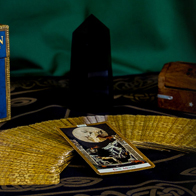
In order to traverse the entire Way of Initiation — whose facilitation and formalization is precisely what the system of Arcana serves — the student must first grasp the system’s “static” aspect: the “Major” Arcanum. Only after mastering it can one proceed to the study of the system’s dynamics: the “Minor” Arcanum.

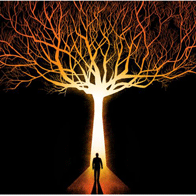
Every traveler must clearly understand that destruction, collapse, and downfall are utterly inevitable and necessary as part of the Way.


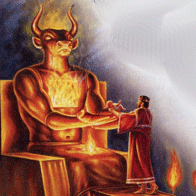
Moloch is the force of sacrificing one’s “original impulses”.


The Myth describes the primordial duality of Mind and Medium as two consubstantial properties of the One in the aspect of its manifestation.
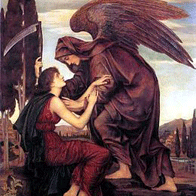
To understand what “kind of destruction” a Magus is dealing with means either to accept that destruction as necessary (and perhaps even to facilitate it), or to oppose it.
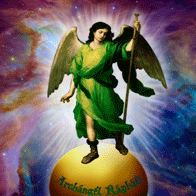
The Divine Healer — Raphael — is the force of “transparency,” of the “health of currents,” manifesting both on the macro- and on the psychocosmic level as the system’s striving for self-control, self-protection, self-organization, and self-differentiation.
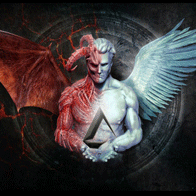
“Ministering” spirits, in their opposition, ensure the dynamic equilibrium of a system, yet they also hinder the integration of its component dualities.
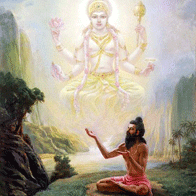
By using the “adoption of divine forms” to evolve the mind, one can locate and objectify powerful ascending currents within oneself that transform the psychocosmos and accelerate its development manifold.