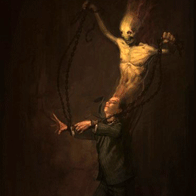
It can be said that any successful Magus is a goetic Magus, even if the Lemegeton is not his reference book.



Other Magic
Пишите мне
Enmerkar's Blog содержит более тысячи авторских статей эзотерической направленности.
Введите интересующий Вас запрос — и Вы найдете нужный для Вас материал
It can be said that any successful Magus is a goetic Magus, even if the Lemegeton is not his reference book.
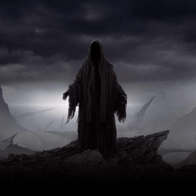
The Magus does not identify himself with the personalities and subpersonalities that flow one into another, nor does he deny them; he watches the play, sinks into his undifferentiated depth and reappears on the surface, avoiding both absolutism and nihilism.


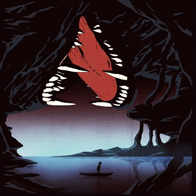
The Demon “breaks down walls”, erasing the boundary between “property”, that is—the actualized reality—of different beings.

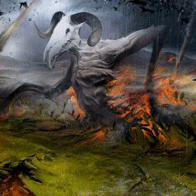
It is vitally important to understand the difference between destruction as making room for fresh creation and destruction for its own sake.
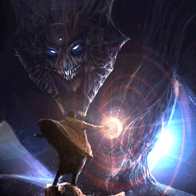
Veelzevul’s influence on the mind consists in the dissolution of hierarchy, the mingling of feelings and emotions, and their interweaving with whims, caprices and passions.
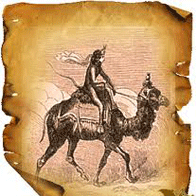
One can resist Paimon by cultivating the right attitude to the physical world and its resources: seeing them as the environment in which the mind develops, an environment important yet secondary to spirit, something not to be neglected but equally not to be idealized.
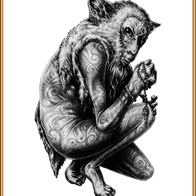
Under the sway of this demon a person absolutizes the value of experience, rejects all that is new and unusual, forcing it into the Procrustean bed of old templates.


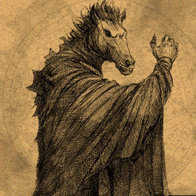
The Magus must act, and his actions must be conscious. The Magus must immerse himself inwardly, but these immersions must not be a cover for laziness and arrested development.


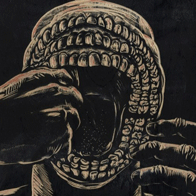
It is vitally important not to lose the capacity for living, active compassion. Only the understanding that allows such activity to be born can be driving and harmonious.

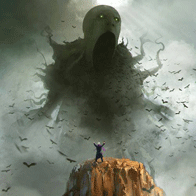
Victory over demons lies in refusing to have anything whatsoever in common with them, without sliding into the opposite pole.
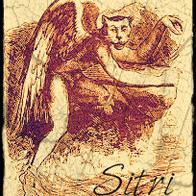
Only by filling himself with compassion and the desire to foster the development of another’s individuality can a Magus resist the spirits of consumption, Sitri among them.
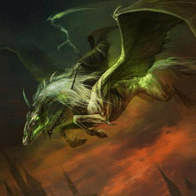
Love must not enslave any of its participants, must not turn anyone into a despot or a slave.

The Magus does not play on others’ faults, but neither does he “smile condescendingly” at them; he attempts, actively yet nonviolently, to promote the development of his mind and the general harmony around him.